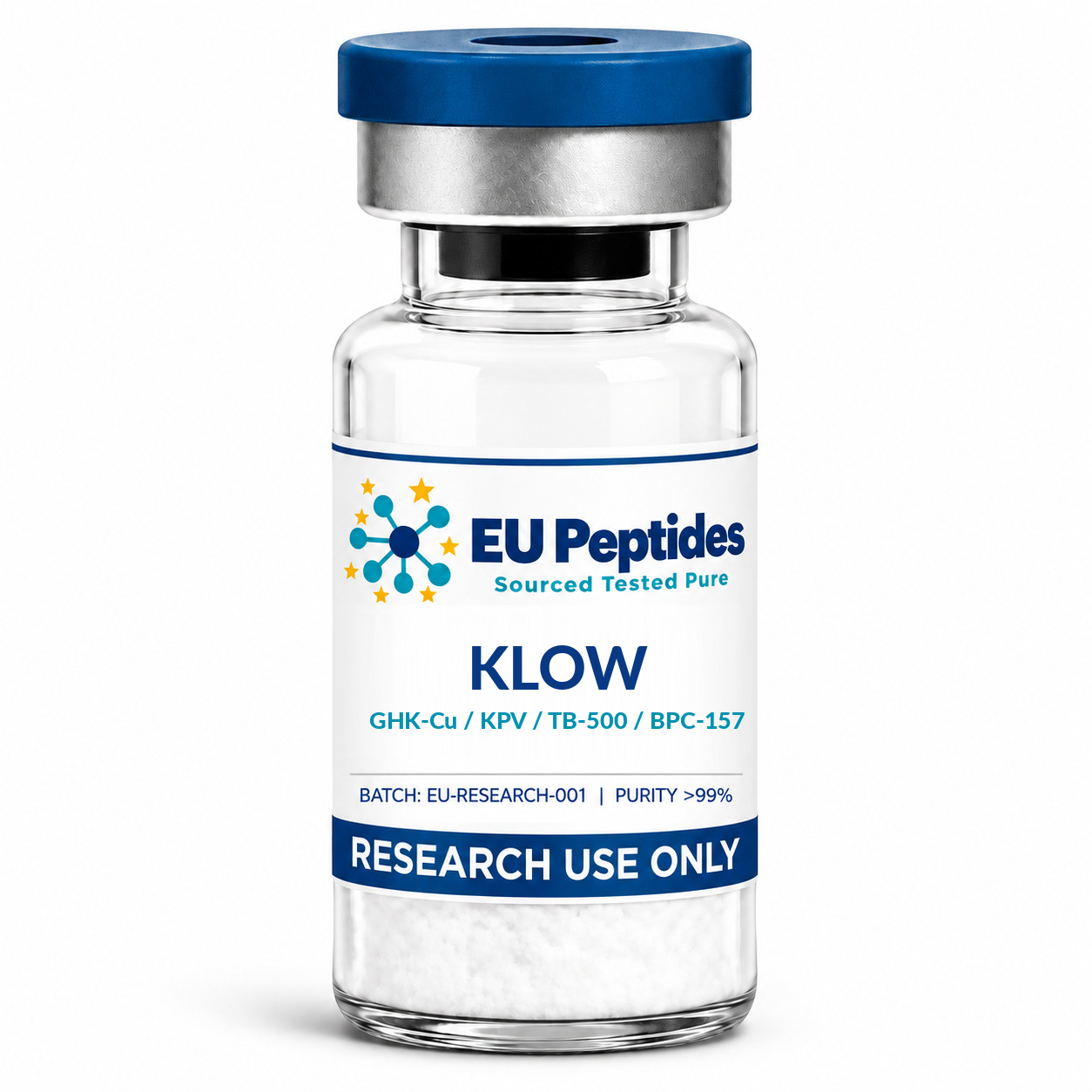
Laboratory reports are available for selected lots. Check each report for its result and stated method.

Wolverine BPC-157 TB-500
≥98% Purity
Class-level spec; selected lots third-party tested
COA Available
Batch report on request · HPLC identity check
Size
10mg
= Lab report published
€39.99
1
Total: €39.99
Free shipping on orders over €200
- If a product does not match the specification on its published COA, contact us with your batch number: we investigate against the lot report and replace any product that fails it, at no cost to you.
- Contact us within 48 hours of delivery with photos of the outer box, inner packing, and any affected vials with labels legible. Confirmed transit damage is replaced at no cost to you.
3–7 days most of the EU · 10–14 Nordics/Baltics
Standard EU from €4.99 · core EU GLS €17.99 · Dispatched within 1–2 business days · Free shipping over €200 · no customs paperwork (EU).
How Paysera and SEPA work
- Pay: send a manual SEPA transfer using the IBAN we email you, or approve a SEPA transfer via Paysera where offered.
- We confirm — Paysera notifies us instantly, or we match a manual transfer when it arrives (usually 1 business day).
- We dispatch — confirmed orders typically ship within 1–2 business days.
Card payments are not currently offered.
Research blend of BPC-157 and TB-500 for laboratory studies. For research purposes only. Not for human consumption.
Volume Pricing
Applied automatically at checkout
| Quantity | Price Each | Total | Savings |
|---|---|---|---|
| 1 unit | €39.99 | €39.99 | — |
| 3+ | €37.99 | €113.97 | 5% off |
| 5+ Most Popular | €35.99 | €179.96 | 10% off |
| 10+ | €33.99 | €339.92 | 15% off |
Class-level specification on record; independent testing on selected lots.
Dispatched within 1–2 business days, shipping from €4.99 in the EU.
Ships across the EU plus Switzerland and the UK where permitted.
Wolverine Peptide Stack: BPC-157 and TB-500
The Wolverine peptide stack pairs BPC-157 and TB-500 for complementary tissue repair and recovery. Common uses include accelerating healing of muscle, tendon, ligament, and connective tissue injuries; reducing inflammation and scar formation; improving range of motion; enhancing wound healing via angiogenesis and collagen organization; and supporting rehabilitation to shorten downtime. BPC-157 (a gastric-derived peptide) promotes local angiogenesis, fibroblast activity and mucosal protection. TB-500 (a thymosin beta-4 fragment) modulates actin and cell migration to speed wound closure and tissue remodeling. Together they are reported to have synergistic effects, BPC-157 aiding localized repair and gut protection, TB-500 supporting systemic cellular migration and remodeling.
What Is the Wolverine Stack?
The Wolverine Stack is an informal name for a research peptide combination containing BPC-157, short for Body Protection Compound-157, and TB-500.
BPC-157 is a 15-amino-acid synthetic peptide associated with a sequence described in gastric research. Investigators have examined its effects on cell survival and migration in experimental systems.
TB-500 is a fragment related to thymosin beta-4. It should not be treated as equivalent to the full-length protein: evidence involving the parent molecule does not automatically establish the same activity for the shorter peptide. Confirm the identity of the supplied material before selecting literature or designing experiments.
The source product description lists 10 mg of each component, giving 20 mg total. Verify these quantities against the label and analytical documentation. The supplied product is intended for laboratory investigation, not human or veterinary administration.
Significance in Scientific Research
Preclinical work involving BPC-157 has examined tendon healing, fibroblast migration and survival under oxidative stress. One study reported increased migration and survival of cultured cells without directly increasing their proliferation. These distinctions matter when describing the peptide’s proposed role in tissue repair.
Related research questions include angiogenesis, the formation of new blood vessels, and changes in inflammation. However, effects observed in animal models or isolated cells do not establish a reliable clinical benefit.
| Research area | What an experiment should distinguish |
|---|---|
| Tendon or ligament repair | Structural measurements, functional outcomes and changes in cell behaviour |
| Angiogenesis | Direct vascular measurements versus changes in associated markers |
| Inflammation | Specific measured responses rather than general claims of suppression |
| Peptide combinations | Individual-component activity versus the response to the complete mixture |
For TB-500, researchers should check whether a cited experiment actually tested that fragment. Studies of thymosin beta-4 cannot substitute for direct evidence about the supplied substance.
Assessing the Combined Peptide Stack
The rationale for combining BPC-157 and TB-500 is that different biological activities might complement one another. A synergistic effect, however, must be demonstrated rather than inferred from separate studies.
A suitable experiment would compare each peptide alone with the combination and an appropriate control. Concentration, exposure time and material quality should remain clearly documented. This approach helps determine whether the combined response differs meaningfully from either component alone.
Claims that one peptide acts locally while the other provides systemic healing are too broad to establish the behaviour of a particular formulation.
Research Outlook
The Wolverine Stack remains an experimental combination. Research into regeneration and tissue repair provides questions for further investigation, but does not establish faster recovery after injury or surgery.
When evaluating a peptide product, prioritise verified identity, analytical records and evidence relevant to the exact material. Findings about BPC-157 or TB-500 individually should be presented separately from claims about the combined product. Further controlled studies are needed to establish whether proposed regenerative effects translate into meaningful, reproducible outcomes.
Related studies:
Product Specifications
- Form: Lyophilized powder
- Purity: ≥98% (class-level specification)
- Storage: −20°C, protected from light
- Intended use: Laboratory research only
- Documentation: Batch certificate of analysis on request
COA Analysis
Selected lots are independently tested. Request the certificate for your batch number before the material enters an assay. Identity should match the stated sequence on the vial label.
For research purposes only. Not for human consumption.
Handling & Storage
Check the lot number against the certificate before the material enters an assay. Reconstitute only when the protocol calls for a working solution, using the solvent and concentration that protocol specifies. A prepared solution is not assumed to have the same storage life as the dry vial.
Store sealed vials at −20°C, protected from light and moisture. For research use only. Not for human or animal administration.
BPC-157
View details
GLOW BPC-157 GHK-Cu TB-500
View details