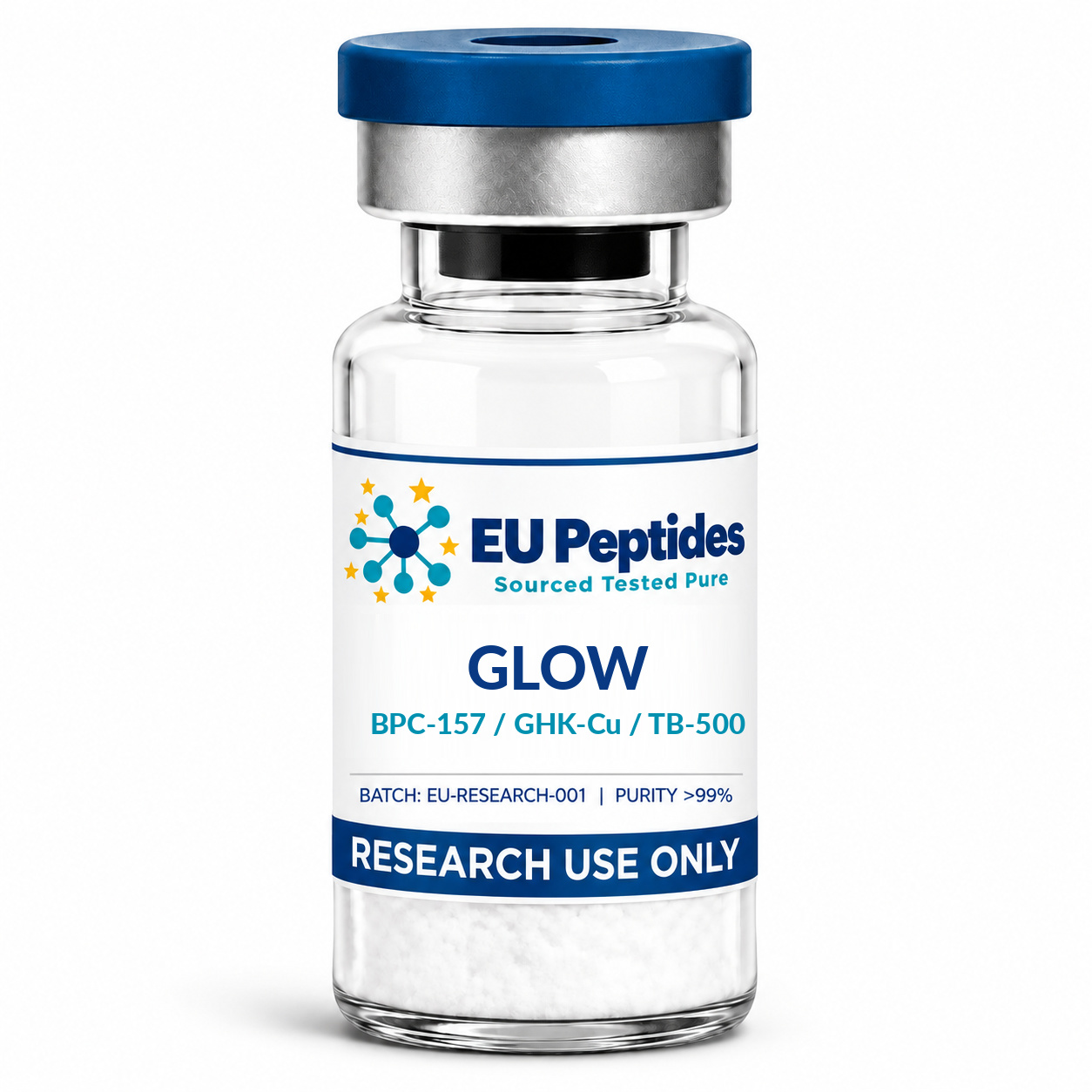
Laboratory reports are available for selected lots. Check each report for its result and stated method.

KLOW GHK-Cu KPV TB-500 BPC-157
≥98% Purity
Class-level spec; selected lots third-party tested
COA Available
Batch report on request · HPLC identity check
Size
10mg
= Lab report published
€39.99
1
Total: €39.99
Free shipping on orders over €200
- If a product does not match the specification on its published COA, contact us with your batch number: we investigate against the lot report and replace any product that fails it, at no cost to you.
- Contact us within 48 hours of delivery with photos of the outer box, inner packing, and any affected vials with labels legible. Confirmed transit damage is replaced at no cost to you.
3–7 days most of the EU · 10–14 Nordics/Baltics
Standard EU from €4.99 · core EU GLS €17.99 · Dispatched within 1–2 business days · Free shipping over €200 · no customs paperwork (EU).
How Paysera and SEPA work
- Pay: send a manual SEPA transfer using the IBAN we email you, or approve a SEPA transfer via Paysera where offered.
- We confirm — Paysera notifies us instantly, or we match a manual transfer when it arrives (usually 1 business day).
- We dispatch — confirmed orders typically ship within 1–2 business days.
Card payments are not currently offered.
Research blend of GHK-Cu, KPV, TB-500 and BPC-157 for laboratory studies. For research purposes only. Not for human consumption.
Volume Pricing
Applied automatically at checkout
| Quantity | Price Each | Total | Savings |
|---|---|---|---|
| 1 unit | €39.99 | €39.99 | — |
| 3+ | €37.99 | €113.97 | 5% off |
| 5+ Most Popular | €35.99 | €179.96 | 10% off |
| 10+ | €33.99 | €339.92 | 15% off |
Class-level specification on record; independent testing on selected lots.
Dispatched within 1–2 business days, shipping from €4.99 in the EU.
Ships across the EU plus Switzerland and the UK where permitted.
KLOW Peptide 80mg?
KLOW Peptide 80mg is a blended formulation containing GHK-Cu, KPV, TB-500 and BPC-157. The blend targets tissue repair, inflammation modulation and cellular regeneration; GHK-Cu (copper-binding, wound signaling), KPV (anti-inflammatory, antimicrobial), TB-500 (actin remodeling, cell migration) and BPC-157 (gut and soft-tissue healing). Reported benefits include faster wound and soft-tissue repair, reduced local inflammation, improved tendon/ligament and joint recovery, gastrointestinal mucosal protection, and skin/hair support via collagen and matrix modulation.
| Component | Quantity per vial |
|---|---|
| GHK-Cu | 50mg |
| BPC-157 | 10mg |
| TB-500 | 10mg |
| KPV | 10mg |
| Total | 80mg |
What Is KLOW?
KLOW is a four-component preparation designed for laboratory research. Combining these substances provides a basis for comparative experiments, but does not establish that their effects are complementary or that the mixture performs better than its individual ingredients.
The peptide preparation should be selected according to the experimental question, supporting documentation and assay requirements. A lyophilized presentation alone does not guarantee purity, stability or reproducible results.
Components and Research Context
GHK-Cu
GHK-Cu is a copper-binding tripeptide investigated in relation to collagen regulation and tissue remodeling. Its copper-dependent properties make the surrounding medium important when interpreting experimental responses.
The inclusion of this compound does not establish that the complete KLOW formulation promotes regeneration or produces the same results reported for the ingredient alone.
BPC-157
BPC-157 is a pentadecapeptide associated with a sequence described in gastric research. Experiments have examined its effects on cell migration and survival under stress. These findings provide questions for further investigation rather than proof that a combined product can accelerate healing.
TB-500
TB-500 is an acetylated fragment of thymosin beta-4. The shorter peptide and full-length protein are distinct substances, so findings about the parent molecule should not automatically be attributed to the supplied fragment. Confirm the identity against the analytical records before selecting references.
KPV
KPV is the C-terminal tripeptide of alpha-melanocyte-stimulating hormone, also called alpha-MSH. Studies have investigated its effects on inflammatory signalling, including NF-κB pathways.
Its mechanism should not be reduced to a claim that it targets MC1R. Experimental work has identified peptide uptake through PepT1 and effects independent of melanocortin receptor signalling in the systems examined.
Designing Four-Peptide Research
Studies using the KLOW blend should compare the mixture with appropriate controls and, where relevant, each peptide separately. This helps distinguish a combined response from an effect driven mainly by one component.
The fixed quantities also limit the ability to vary individual concentrations independently. Document exposure time, preparation conditions and endpoints so that findings can be interpreted and compared with other experiments.
Quality and Analytical Documentation
Request a batch-specific certificate of analysis and match the COA identifiers to the supplied vial. If third-party testing is advertised, review the corresponding report.
HPLC can provide information about purity, while mass spectrometry offers complementary identity evidence. For a peptide blend, check whether the analytical method distinguishes the ingredients and supports the stated proportions. A single purity percentage does not establish the quantity of every component.
Storage and Reconstitution
Follow the supplier’s validated instructions for the lyophilized material. If those instructions specify -20°C, maintain the stated conditions and protect the sealed container from unsuitable light and moisture exposure.
Before reconstitution, confirm that the solvent and preparation method suit all four ingredients. Stability after mixing must be supported by product-specific evidence rather than inferred from the individual substances.
KLOW is supplied for research use only, not for human or veterinary administration, consumption or treatment.
Related Studies:
Product Specifications
- Form: Lyophilized powder
- Purity: ≥98% (class-level specification)
- Storage: −20°C, protected from light
- Intended use: Laboratory research only
- Documentation: Batch certificate of analysis on request
COA Analysis
Selected lots are independently tested. Request the certificate for your batch number before the material enters an assay. Identity should match the stated sequence on the vial label.
For research purposes only. Not for human consumption.
Handling & Storage
Check the lot number against the certificate before the material enters an assay. Reconstitute only when the protocol calls for a working solution, using the solvent and concentration that protocol specifies. A prepared solution is not assumed to have the same storage life as the dry vial.
Store sealed vials at −20°C, protected from light and moisture. For research use only. Not for human or animal administration.