 View details
Research compound
GHK-Cu
A copper tripeptide studied in collagen and extracellular matrix models.
View compound
Research area
This category is for research peptides used in laboratory work on skin: dermal tissue, the extracellular matrix, and the cell processes tied to maintenance and repair. The products are supplied for research use. Being listed here does not mean a compound firms skin, speeds healing, reduces wrinkles, or produces any cosmetic result in people. Those are separate claims, and this page does not make them.
View details
Research compound
A copper tripeptide studied in collagen and extracellular matrix models.
View compoundSkin research is a wide field. Some studies ask how cells organize the structural proteins around them. Others ask how tissue responds to an experimental injury, or how a defined cell type behaves in culture. A paper might measure collagen. Another might track glycosaminoglycans, proteoglycans, or fibroblast activity. Each of those is a real endpoint. None of them is automatically a visible change in human skin. An animal result, or a result in a dish, stays inside the model that produced it.
Peptides are one way into that work. A short, sequence-defined chain can be applied to a culture or an experimental wound and then measured against a specific marker. That is useful if the protocol names the marker. It is also easy to over-read. A shift in one component of connective tissue, at one time point, does not describe the whole tissue, and it does not travel from a rat wound chamber to a person on its own.
Read the category with that limit in mind. The materials here have appeared in work on dermal structure, matrix remodeling, and related cell activity. Overlap in topic is why they share a page. Overlap is not shared activity. Two skin-research peptides can point at different cells, different matrix components, and different experimental readouts. A finding for one does not support a claim about another, and studying them separately does not show what a combination would do.
The category label is only a way to browse. If a protocol names a peptide, the listing has to match that peptide.
Start with identity, not with the research summary. Review the stated sequence where it is given, the amount supplied, and any batch analytical report. Then see what the report measured. Identity, purity, and quantity are different tests. A document that confirms one of them does not confirm the others, and a report on an earlier lot does not describe the vial in front of you.
Formulation matters just as much as the name. A peptide and a metal complex of that peptide are related materials, not the same material. A finished preparation that adds a carrier, a delivery system, or other ingredients is a further case. Those extras can change how a published result should be read. If the paper used the peptide alone and the listing is a blend, or the reverse, the comparison is weak.
The notes on this page are context. They explain why a compound was placed in the dermatology collection. They do not replace the study, and they do not set the concentration, exposure time, or endpoint. Those belong to the protocol. Where analytical paperwork is available, check that it matches the product and the batch. Identity and purity help characterize a material. Neither one establishes biological performance, or fitness for a particular experiment.
| Vial | What is in it | What the studies look at |
|---|---|---|
| GHK-Cu | GHK (glycyl-L-histidyl-L-lysine) complexed with copper. This is distinct from GHK without copper. | Cell-culture and animal studies examining collagen and other components of the structural material around cells, including work in rat wound chambers and dermal fibroblast cultures. |
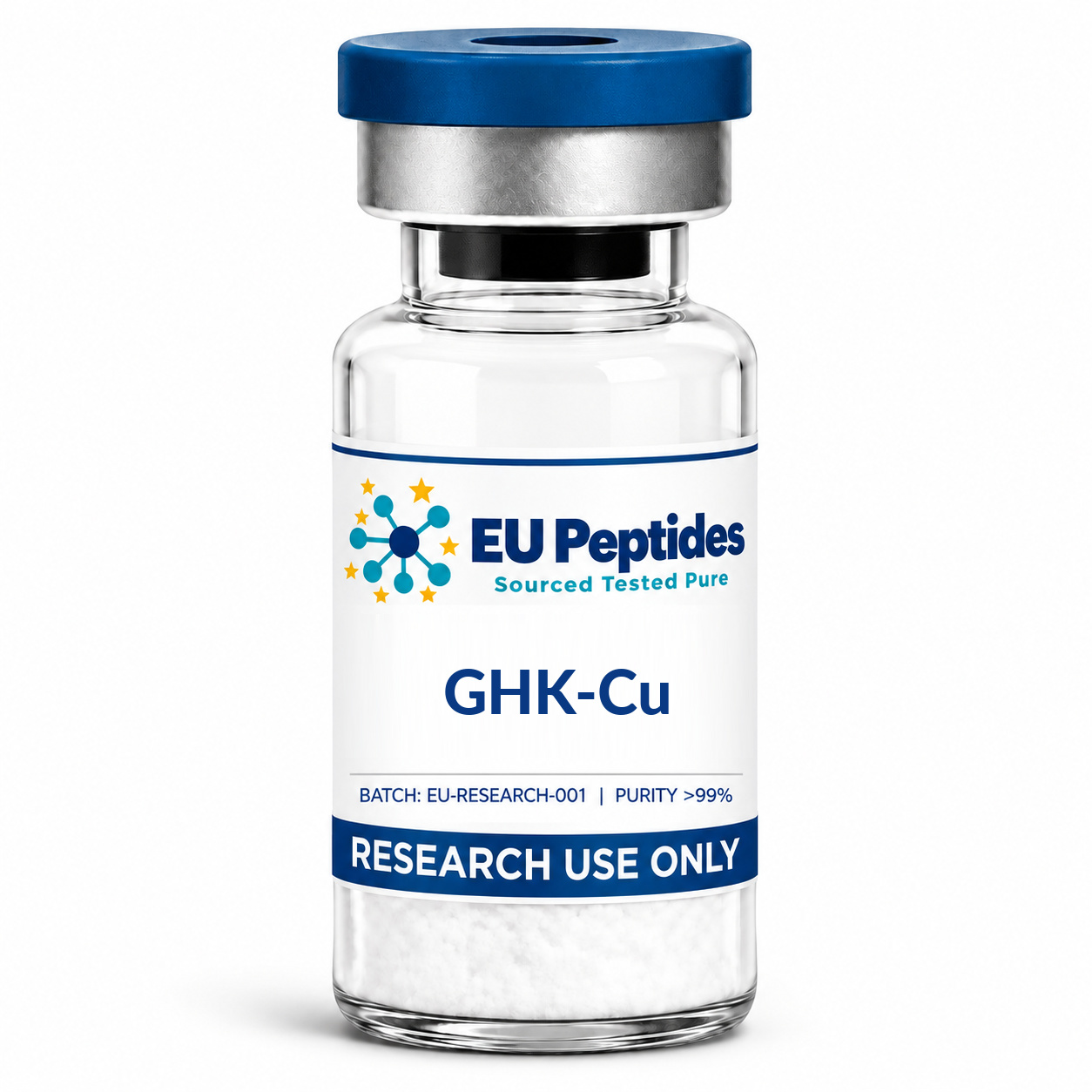
GHK-Cu is the copper complex of glycyl-L-histidyl-L-lysine, the tripeptide usually abbreviated GHK. The copper is part of the identity. GHK and GHK-Cu should not be swapped when you compare a product with a paper. Research on GHK-Cu alone should also be kept separate from research on a finished formula that contains other ingredients. A carrier or a combination introduces variables. Ignore them and the result is no longer about the compound you think it is.
Published work has examined GHK-Cu in cell culture and in animal models, mostly around connective tissue and the skin’s extracellular matrix. The matrix is the structural material around cells. It also forms part of the environment through which cells signal and move. In dermatology research, changes in that matrix are one way to study tissue organization, remodeling, and response to damage. Collagen is the major structural protein in skin, but skin biology is not collagen alone. Investigators also look at the molecules around the fibers, the cells that produce matrix components, and the processes that regulate turnover.
One line of that work used rat wound chambers and reported changes in the accumulation of collagen and glycosaminoglycans after exposure to GHK-Cu. Other experiments have looked at glycosaminoglycans and small proteoglycans in experimental wounds and in rat dermal fibroblast cultures. Those studies ask how parts of the connective-tissue environment respond to a defined material. The results stay specific to the model and the conditions. They support further investigation of the compound. They do not demonstrate a cosmetic benefit.
Fibroblasts are the cells that produce and maintain much of that connective tissue, so they come up often in dermal structure and remodeling work. Research with GHK-Cu is one way to look at selected parts of that activity in a controlled setting. Depending on the design, a study may measure matrix production, where structural components end up, or what changes over a defined period. Interpreting any of it depends on the model, the concentration, the exposure time, and the comparison groups. Together, those details decide what a finding can support and where it cannot.
The GHK-Cu listing carries composition, quantity, and available specifications. Use those to match the material in the protocol or the reference, including whether the reference used the copper complex alone. The category only tells you this is the dermatology material currently offered. It does not rank the listing, and it does not turn a wound-chamber or culture result into an effect on human skin.
All products are supplied strictly for laboratory and analytical research. They are not for human consumption, medical use, or veterinary use.